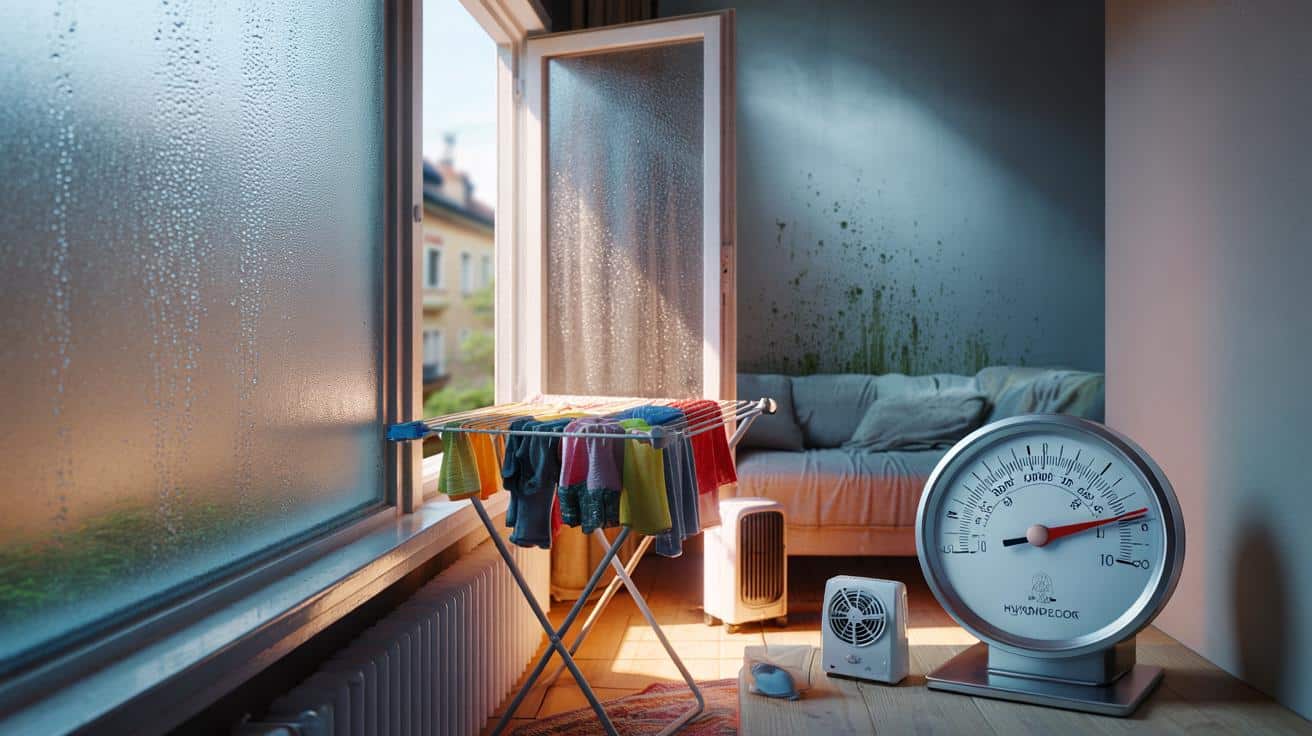
One load, one rack, one room with the window on “tilt” — and within an hour the air turns heavy, the glass fogs at the edges, and the paint near the cold wall quietly drinks moisture. The sneaky part is the number: there’s a humidity level where a normal chore becomes a mold trigger. Cross that line often enough and spores find a home behind wardrobes, on window reveals, and in ceiling corners. It doesn’t smell dramatic on day one. It creeps in.
The radiator ticks in the late afternoon light. Socks clip onto the rack like flags after rain, and the small hygrometer on the shelf creeps from 46… to 55… to 61. I crack the window, watch a flock of pigeons drift past, and feel the room breathe out for a moment before the chill pushes back. A neighbor once pulled her couch forward and found black freckles marching up the wall. She thought it was dust. She stopped sleeping in that room. The number to fear is smaller than you think.
Mold alert starts here: the humidity value that flips the risk
There’s a practical line most building biologists agree on: the danger starts at 60% relative humidity. Hit 65% and hold it for a few hours, and the risk climbs sharply. A single drying cycle can add 1.5 to 2.5 liters of water to the air — more if you skip the high-speed spin.
Picture a 20 m² room with a 2.5 m ceiling. That’s roughly 50 cubic meters of air. One average load can push a comfortable 45% up past 60% before you finish pinning the sleeves. At the outer wall, where surfaces run cooler, the microclimate near paint can reach 80% relative humidity, even while the middle of the room looks “fine.” *On the windowpane, tiny beads of water gather like proof you can’t ignore.*
Here’s why that number matters. Relative humidity rises as temperature drops, and cold corners act like magnets for moisture. When night falls and the room cools, yesterday’s “58%” can translate to wall-surface air well above 80% — the threshold where mold spores stop waiting and start colonizing. **For indoor drying, the safe band is 40–55% in the room air, with 60% as a real red line.** Go past it often, and you’re not just drying clothes; you’re watering your walls.
How to dry laundry indoors without crossing the line
Work with the “60% rule.” Place a cheap digital hygrometer at chest height, away from the rack and the window, and watch the rise. When it nudges 58–60%, do a sharp cross-vent: two windows wide open, 5–10 minutes, doors closed to isolate the room. Rack in the smallest heated room with a window, door shut, and a tiny fan nudging air upward. If you have a dehumidifier, set it to 50% and park it a meter from the rack. Spin laundry at 1200–1600 rpm before it ever meets the air.
People often dry in the living room, drape shirts on radiators, and leave windows cracked all day. That cools walls, slows drying, and nudges humidity up where it hurts. Let’s be honest: nobody really does that every day. A better flow is short and decisive — ventilate hard, then close. Keep the rack 15–20 cm off the wall. Avoid bedrooms and cold hallways. If it’s raining for days, dry fewer items per cycle or switch to a heat pump dryer for the time being.
We’ve all had that moment when the glass fogs and you pretend it’s cozy. The meter says something else, and walls remember.
“At 60% you’re flirting with trouble; at 65% sustained, you’re feeding it,” says a building hygienist I called for this story. “Your nose will notice late. Your meter won’t.”
- Target room humidity: 40–55%
- Trigger action at: 58–60%
- Critical band: 65%+ for several hours
- Vent windows wide for 5–10 minutes, then close
- Rack in small heated room with door shut
- Use a dehumidifier set to 50% if available
When the number spikes anyway: act fast, not loud
If the meter touches 65% while clothes are up, pause the drying. Move the rack to the bathroom or kitchen, run an extractor fan, and do a full cross-vent for 10 minutes. Warm the room back to its normal setpoint so surfaces don’t sit cold. **If you see condensation on glass or sills, wipe it — don’t let droplets evaporate back into the room.** Spot-check cold corners with your hand; if they feel clammy, give them airflow with a desk fan for half an hour. At the next wash, increase spin speed, halve the load on the rack, and switch to a morning drying window, when outdoor air is often drier. A tiny habit shift beats a repaint months later.
| Point clé | Détail | Intérêt pour le lecteur |
|---|---|---|
| Risk threshold | Room RH becomes risky from 60%; 65%+ for hours accelerates mold | Know the exact number that turns a chore into a hazard |
| Moisture per load | 1.5–2.5 liters released into the room without proper spin and ventilation | Quantifies the invisible water floating around your walls |
| Safe routine | Dry in a small heated room, door closed, cross-vent at 58–60%, aim 40–55% RH | Step-by-step method to keep clothes drying and walls healthy |
FAQ :
- What exact humidity value makes indoor drying dangerous?Cross 60% RH and you’re in the danger zone. Hold 65% or more for several hours and mold risk rises fast, especially on cold surfaces.
- Is it okay to dry laundry in the bedroom?Not ideal. Bedrooms run cooler at night and surfaces hit higher surface humidity. Use a small heated room with a window and close the door.
- How often should I ventilate while drying?Watch the meter. At 58–60% RH, do a 5–10 minute cross-vent with windows wide open, then close. Repeat if humidity climbs again.
- Do I really need a dehumidifier?Not always. A strong spin cycle, a small fan, and smart ventilation can be enough. In winter or tiny flats, a unit set to 50% makes life easier.
- How do I spot early mold risk?Look for persistent window fog, musty smells, or gray dots on silicone, sills, and corners. Wipe condensation, improve airflow, and keep RH below 55% day-to-day.