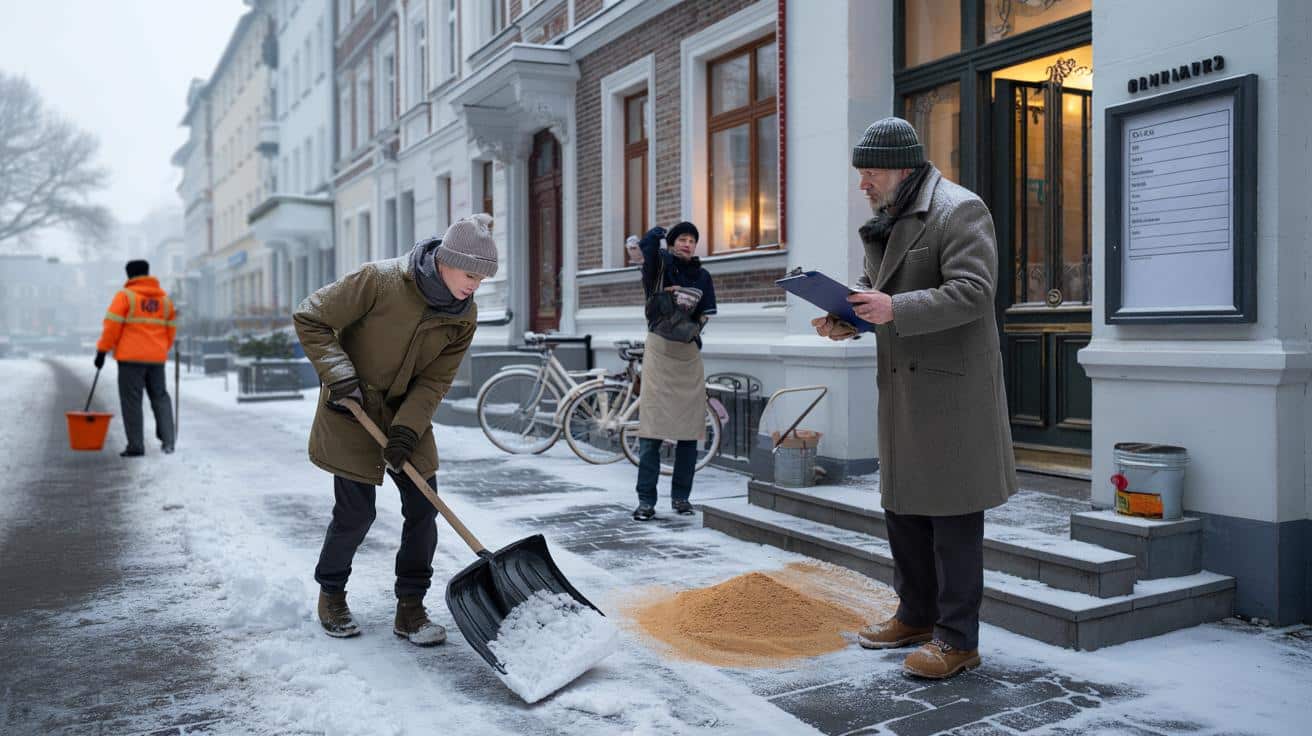
A fresh layer of snow, a slippery sidewalk, and a neighbor staring at you over a shovel: who’s actually on the hook to clear it? In Germany, the legal answer catches many by surprise. Tenants, owners, or the city—who must grab the shovel depends on rules that feel more like a winter maze than a simple chore.
By eight, the sound of scraping shovels echoed from courtyard to curb, paired with the crisp rhythm of boots on powder. A landlord in a wool hat pinned a note to the entrance: “Räum- und Streupflicht: heute Wohnung 3.”
I watched a young renter glance up from her phone, scan the name list, then sigh at the snow-packed steps. She walked back inside, reappeared with a wobbly plastic shovel, and began clearing a one-meter stripe, careful not to throw snow onto the road. Winter has a way of revealing who wakes first.
Across the street, a shop owner spread grit like he was salting a steak, while a cyclist skidded and cursed in Bavarian. We lock eyes in moments like this. Who’s responsible if someone falls?
Here’s the twist.
Mieter oder Eigentümer—who really has to shovel?
German law starts from a simple place: keeping paths safe is a “Verkehrssicherungspflicht,” a duty to prevent obvious hazards. Cities and municipalities hold that duty for public sidewalks, yet many shift it to property owners through a Gemeinde-Satzung. Owners, in turn, often pass it further down to tenants via Mietvertrag or house rules.
The result: the person doing the morning shoveling may not be the person who owns the building. **If your lease says you’re on duty, a judge will hold you to it.** Typical clearing times sit around 7:00 to 20:00 on weekdays and 9:00 to 20:00 on Sundays, but hours vary by city.
In practice, that means a safe, walkable strip—usually about a meter wide—so two people can pass without stepping into the road. Steps, entrances, and the path to bins matter too. Many towns restrict Streusalz due to damage it causes; sand or grit is preferred, salt only for black ice. That tiny line in your lease can carry a very real shovel.
Take a shared building in Munich as a snapshot. The landlord posts a rotation list in November, assigns one apartment per day, and keeps a bag of grit near the entrance. Most winter days, that rhythm works. Then Sunday hits, snow keeps falling, and the schedule collides with brunch plans.
A slip-and-fall case followed a January thaw: a tenant argued ongoing snowfall excused them, while a neighbor cited a danger zone near the steps. Courts tend to look at what’s “reasonable”: clear after snowfall ends, and at intervals if it keeps coming. Over the years, rulings have awarded several thousand euros in damages where duty was ignored. One icy patch can become an expensive line item.
Delegation doesn’t erase the owner’s role. **Owners remain responsible for organizing and monitoring, even when they delegate.** A clause in the rental contract or Hausordnung must be clear. If it’s vague or never agreed, the landlord is still on the hook. Elderly or disabled renters can’t be forced into unrealistic tasks; substitutes or a Winterdienst are normal solutions. And if you’re away on holiday and the duty is yours, you still need a backup. Snow doesn’t pause for plane tickets.
How to handle Räum- und Streupflicht without losing your weekend
Start with the paperwork. Check your Gemeinde-Satzung, then your Mietvertrag and house rules to see who carries the Räum- und Streupflicht. If it’s you, set a simple routine: clear a 1–1.2 m path, steps first, push snow to the side without blocking drains or driveways, then spread grit where footprints compact the ice.
Lay grit before the freeze if a refreeze is forecast. Keep a bucket near the entrance and a small shovel by the door for fast touch-ups. Many cities limit salt—so keep sand, lava granulate, or grit handy. If you travel, book a Winterdienst service or arrange a neighbor swap. A calendar on the hall wall beats guesswork when the first flurries arrive.
We’ve all lived that moment when the alarm rings at 6:30 and the world outside is white and silent. Don’t pour hot water on ice, don’t throw snow onto the road, and don’t bury hydrants or mailboxes. **Grit beats salt in most German cities.** Let’s be honest: nobody does that every day.
“Räum- und Streupflicht isn’t about spotless perfection—it’s about reasonable safety,” says a Berlin property manager. “A clear stripe, gritted steps, and timely checks when the weather shifts.”
- Check times locally: many towns expect paths clear by 7:00 on weekdays, later on Sundays.
- Width matters: aim for two people to pass without stepping on the street.
- Grit smart: sand or lava granulate for traction, salt only for black ice where allowed.
- Plan absences: name a substitute in writing, and share contacts on the hallway noticeboard.
What the law really means for your winter
The surprise is how ordinary the rule feels once you see it in motion. Cities push duty to owners, owners share it with tenants, and everyone stays accountable in a chain that only works if each link shows up. It’s civic, a little stubborn, and very German—this belief that a safe city begins at the threshold of each building.
If you’re a tenant, the fastest win is clarity. Pull your lease, mark the duty days, and make a small kit so “I’d do it, but…” never becomes a real hazard. If you’re an owner, treat winter like a project: define who does what, document it, and keep light-touch oversight. A five-minute call after a snowfall can prevent a five-figure claim after a fall.
Germany’s winter law doesn’t ask for heroics, only for reasonable care. That’s the quiet bargain: you keep a path safe, and others do the same for you. The city becomes walkable again, one cleared stripe at a time.
| Point clé | Détail | Intérêt pour le lecteur |
|---|---|---|
| Who must shovel? | Municipalities often shift duty to owners, who can delegate to tenants via lease/house rules. | Know if the shovel is legally yours before the next snowfall. |
| When and how? | Typical times 7:00–20:00 (weekdays), 9:00–20:00 (Sundays); clear ~1 m and spread grit. | Avoid fines, disputes, and liability with a simple routine. |
| Limits and liability | Salt often restricted; owners must supervise even if delegating; insurance covers third-party claims. | Prevent costly injuries and protect yourself with the right cover. |
FAQ :
- Who is legally responsible for the sidewalk in front of a building?Municipalities carry the baseline duty, but most local statutes transfer it to property owners. Many owners delegate it to tenants via the lease or a binding house rule.
- Can a landlord make tenants shovel?Yes, if the Mietvertrag or incorporated Hausordnung clearly assigns the duty. The landlord still must organize and monitor; delegation doesn’t erase that oversight.
- What are the usual clearing times?Often 7:00–20:00 on weekdays and 9:00–20:00 on Sundays/holidays. Times differ by city and can be longer for shops. Clear after snowfall and at reasonable intervals during continuous snow.
- Is using salt allowed?Many cities restrict Streusalz. Use grit, sand, or lava granulate for traction and salt only for black ice where permitted. Check your local Satzung to avoid fines.
- What if I’m away or physically unable to shovel?If duty is yours, you must arrange a substitute or a Winterdienst. For health or age constraints, talk to your landlord about alternatives; courts expect reasonable solutions, not unsafe burdens.