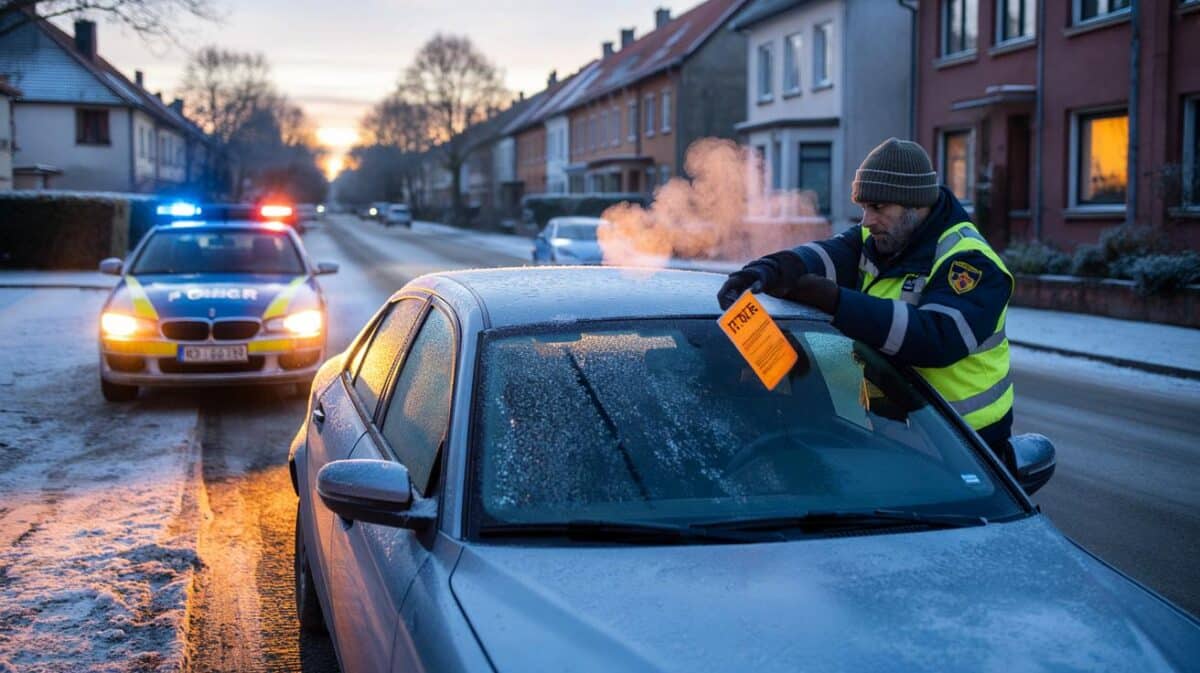
Now a small symbol on the sidewall decides whether you’re legal or not, and a cold morning could turn into a fine, a point in Flensburg, and awkward insurance questions. The trap? Those familiar M+S markings many of us trusted for years. The timing? As of autumn 2024, the rules changed while most people were thinking about Halloween, not rubber.
The first frost came early this year. A café window fogged with breath, a line of commuters huddled in scarves, and a quiet tension on the roads only drivers notice. I watched a neighbour kneel beside his SUV, brush road dust from the sidewall, and squint at two letters he’d always relied on: M+S. He looked up, unsure, then down again, as if the tire might whisper the answer back.
We’ve all had that moment when the rules changed and nobody told us. The police checkpoint at the ring road had a steady rhythm to it, and the officer’s flashlight was patient, not hostile. “Do you have the mountain-and-snowflake?” he asked, almost apologetic. The neighbour shrugged. The flashlight moved closer. And just like that, the old logic of winter tires didn’t apply anymore.
Why your M+S winter tires just became a legal risk
Germany tightened the definition of a “winter tire” and closed the grace period. The short version: **M+S is no longer enough** to count as a winter tire when roads are wintry. Only tires with **the Alpine “three-peak mountain snowflake” (3PMSF) symbol** meet the rule. That carved little mountain isn’t decoration. It means the tire passed a snow-traction test. M+S never had to prove anything.
For years, there was a transition. If your M+S tires were produced before 2018, they were tolerated. That ended on **from 1 October 2024**. Picture a driver in Hanover with a 2016 set: lightly used, still plenty of tread, still proud of the purchase. A light snowfall hits the B6, traffic crawls, and a routine control finds only M+S on the sidewall. Fine, one point, and a sinking feeling in the stomach. ADAC has warned for months that millions of M+S-only tires are still rolling. Many will find out the hard way.
Here’s the nuance people miss. You can still drive any legal tire when conditions are dry and mild. The offense appears once roads turn to snow, slush, ice, or frost and your car lacks 3PMSF on the driven wheels. That means the same set can be perfectly legal at noon and a liability at dusk if the temperature drops. It’s not just law-book logic. 3PMSF tires brake shorter and track straighter in real snow. M+S is a promise. 3PMSF is proof.
What to check today and how to fix it fast
Start with the sidewall. Look for a small mountain icon with a snowflake inside—3PMSF—near the size and speed ratings. If you only see “M+S,” find the DOT code: four digits telling week and year, like 2317 for week 23 of 2017. Anything M+S-only, no 3PMSF, produced before 2018, became a problem this winter. Measure tread depth while you’re there: 1.6 mm is legal, 4 mm is the real-world minimum once snow enters the chat.
Don’t mix: 3PMSF on one axle and M+S on the other gives weird, risky handling. All-season tires can be fine for Germany’s changing winters, but they need 3PMSF, not just M+S. Match the load and speed ratings listed on your registration. Rotate sets front to back at the start of each season. Store them cool and out of sunlight. Let’s be honest: nobody really does that every day. A decent tire shop will mark, store, and rotate for you, and it’s cheaper than a deductible.
“The sticker shock of new winter tires fades the moment you have to brake downhill on fresh snow,” says a Berlin tire fitter who’s seen every kind of panic stop.
- Take a photo of your sidewall today and circle the 3PMSF or M+S marks for clarity.
- If you’re M+S-only, book a changeover before the first real cold snap and ask for 3PMSF all-season if you drive mostly in cities.
- Check your insurer’s conditions; some reduce payouts if you ignored winter tire rules in snow.
- For company cars, send fleet policy a one-line note: “Confirm 3PMSF compliance by October.”
- Keep a simple glovebox checklist: tread, pressure, symbol, torque, triangle, vest.
Money, penalties, and the grey areas nobody explains
Getting caught with M+S-only tires during wintry conditions isn’t about shaming careless drivers. It’s about predictable braking. Fines usually start around €60 and one point in Flensburg; if you obstruct traffic or cause danger, the amount climbs. Owners who let someone drive their car like this can also be fined. Insurers may reduce payouts if illegal equipment contributed to an accident. That conversation always stings.
Then come the edge cases. SUVs don’t get a pass. Nor do rental cars; if a rental hands you M+S-only rubber, swap vehicles or have them note it in writing. Trucks and buses follow their own axle rules, but 3PMSF is the benchmark there too. Motorcycles are a small exception in some scenarios, yet every rider knows cold rubber feels different. If you drive across borders, Austria and parts of Italy enforce 3PMSF in winter periods with far less patience than German city cops.
Here’s the quietly stressful bit: the weather moves faster than the law. One hour of sleet can turn a routine errand into a legal misstep. Some drivers will risk it, trusting tread depth and a careful foot. The braking tests don’t care. On compact snow, 3PMSF tires stop meters earlier at common speeds, which is the difference between a story to tell and a claim form. A small mountain on the sidewall is suddenly the most valuable real estate on your car.
Where this leaves you as winter deepens
Your choice isn’t just new winter tires or nothing. It’s the kind of winter you drive through, the roads that matter to you, and the margin of error you want in your back pocket. City commuters often pick 3PMSF all-seasons to skip the seasonal swap. Mountain drivers still swear by dedicated winter sets. Both are right in their own way, so long as that alpine symbol is there and the rubber isn’t tired and glassy with age.
There’s also a cultural shift under way. For years, we equated M+S with a winter mindset. The 3PMSF rule feels stricter because it is, and it arrived with little ceremony. Shops are busy, stock is patchy, and your neighbour will insist his old tires are “as good as new.” They aren’t. Rubber ages. Brakes get tested on hills you barely notice in summer. A quiet cul-de-sac becomes a curling rink before sunrise.
One last thought before you scroll on. The law is the nudge, not the point. The point is that winter driving is improvisation made safer by preparation. Swap early, skip drama, and keep a screenshot of your sidewall symbols for the next checkpoint or curious friend. The first big snowfall will make this whole conversation feel very real. You’ll feel it in your palms on the wheel.
| Point clé | Détail | Intérêt pour le lecteur |
|---|---|---|
| 3PMSF required | Only tires with the Alpine symbol count as winter tires in wintry conditions | Clear signal of what to look for on your sidewall |
| Grace period ended | M+S-only tires produced before 2018 lost their exemption on 1 Oct 2024 | Avoid fines, points, and insurer pushback |
| Practical checks | Find 3PMSF, read DOT date, keep >4 mm tread for real snow | Simple steps to become compliant today |
FAQ :
- Are M+S winter tires now illegal in Germany?They’re legal to sell and use, but they don’t fulfill the winter tire rule in snow, ice, slush, or frost unless they also have 3PMSF.
- How do I identify the correct symbol?Look for a mountain with a snowflake inside (3PMSF) on the sidewall near size and speed markings.
- What happens if I’m stopped in wintry conditions with M+S-only tires?Expect a fine (often around €60) and one point; higher penalties apply if you obstruct or crash.
- Are all-season tires acceptable?Yes, if they carry 3PMSF. All-season with only M+S doesn’t meet the winter rule anymore.
- Will my insurer deny a claim?If illegal equipment contributes to a crash in winter conditions, insurers can reduce payouts. Document your tires and switch early.