A thin white layer on the car roof looks innocent. In Germany, it can quietly turn into a legal landmine. One forgotten chore on a freezing morning, and you’re suddenly staring at a fine and points on your license. The catch: if things go wrong, those points can climb fast. And yes—this winter blind spot still trips up thousands.
You crack the door, the cold hits, and your breath fogs the mirror. You scrape a clear rectangle on the windshield, watchful of time, coffee cooling on the dash. The roof? A shimmering quilt of powder. You tell yourself it’ll blow off in the first kilometer.
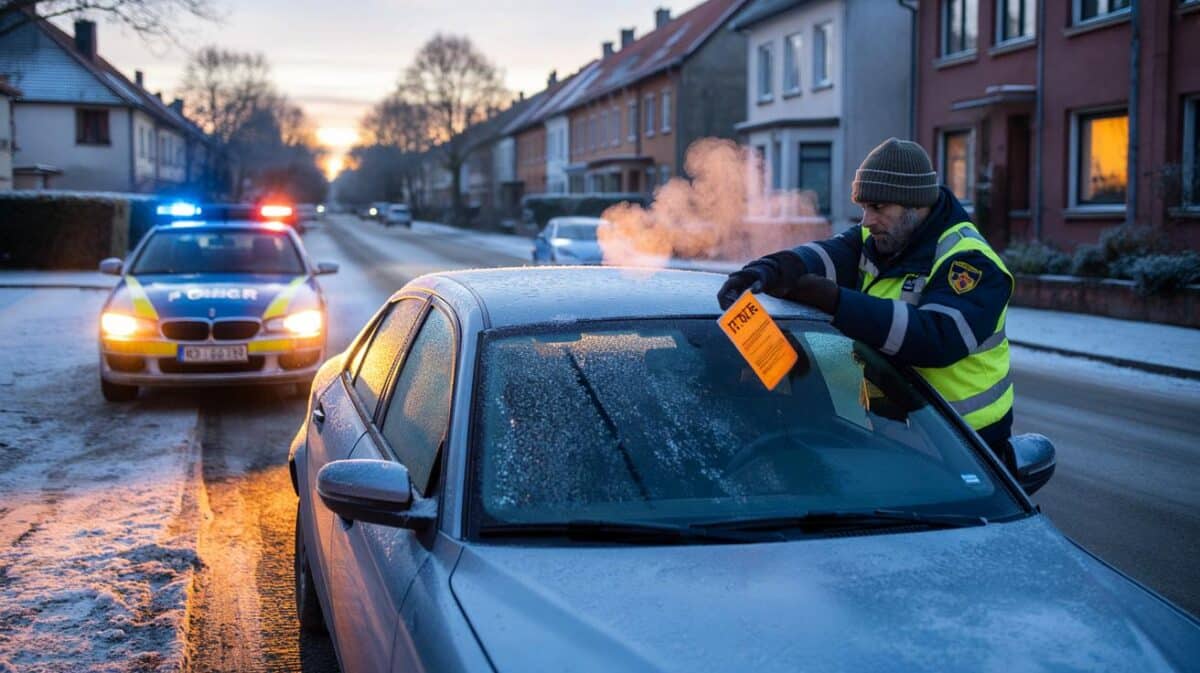
At the third traffic light, you brake. A sheet slides forward like a lazy glacier, smearing the glass. Panic, wipers, a smear of ice crystals and slush. Twenty minutes later, a police patrol pulls you over. Their message is simple—your morning shortcut just became an offense. The bill won’t stop at cash.
On a calm street, a split-second choice turns into paperwork and penalty points. What felt minor turns major once it’s written in black and white. One rule sits behind it all, and it’s stricter than you think.
Snow on the roof: the winter offense that sneaks up on you
Snow on the roof is not harmless. German traffic law treats it as a safety failure, not an aesthetic slip. Under §23 StVO, the driver must keep the vehicle in a condition that doesn’t endanger anyone, including clearing snow and ice from all surfaces.
A dusting can become a whiteout under braking. A plate of ice can fly off at 80 km/h and turn into a projectile. Police don’t need an accident to pull you over—they just need to see a risk. That’s the bit many people forget in the rush for coffee and warmth.
Numbers add clarity. The Bußgeldkatalog lists typical fines starting around €25 if you drive with uncleared snow. If your neglected roof endangers others, the fine jumps—often around €80—and you can get 1 point in Flensburg. Cause damage and that rises to roughly €120 plus 1 point. When injuries or a serious crash enter the picture, prosecutors can treat it as a criminal offense—suddenly you’re facing a driving ban and **up to three points in Flensburg**. The “just snow” idea doesn’t hold.
How to clear your car fast—and do it right
Clear the roof first. Use a soft snow broom or a foam-edge squeegee to push the snow backward, not sideways. Work from roof to hood to windows, then lights and license plates. If you start with the windshield, gravity will undo your work the moment you brake.
Warm up the seals and mirrors with the car heater while you sweep. De-icer spray helps with thin ice on glass, but don’t hack at the roof with a hard scraper—you’ll scratch the paint. Knock packed snow from wheel arches and the spoiler. Finish with a quick check: roof, bonnet, windows, lights, camera sensors, and the rear shelf if you opened the hatch.
On a tight morning, habits matter. Keep the broom in the trunk, not the basement. Wear thin gloves you can actually grip with. Let the air recirculation off so the windshield doesn’t fog again at the first breath of heat. *Tiny rituals beat fines, every time.*
Common mistakes—and how to dodge them without freezing
We’ve all done it—scraping a postcard-sized peephole and telling ourselves we’re good. Let’s be honest: nobody polishes their car like a showroom in a sleet storm. The trick is to be street-smart about what police actually look for. A clean roof, a clean rear window, and no loose plate of ice hanging around the edges goes a long way.
Skipping the roof is the classic error. Another is forgetting the rear lights and cameras; the radar can see through rain, not through iced plastic. Don’t pour hot water on the glass—it can crack. Don’t rely on the wipers to bulldoze a snow drift. And don’t leave a fluffy “cap” because it looks cozy. You’re driving, not topping a cupcake.
One officer I spoke to put it bluntly:
“If I can see snow on your roof, I can see a reason to stop you. If I see it slide, I see a reason to write.”
- Keep a soft broom and de-icer in the car all winter.
- Roof first, then windows, then lights and cameras.
- Tap frozen door seals gently—don’t pry them.
- Clear the bonnet and the grille; snow shifts under braking.
- Do a 10-second walkaround before you roll.
License, insurance, and the ‘forgotten fine’ spiral
Here’s where it bites. A quick stop for snow on the roof begins as a small fine, and many drivers treat it like a parking ticket. If that snow turns into a hazard—blinding a driver behind you, causing a swerve, or cracking a windshield—you’re looking at money, points, and liability. Some insurers may adjust fault when negligence is clear. Fleet vehicles and vans face even sharper scrutiny, and trucks with “ice plates” on the roof are a known winter hazard. Soyons honnêtes: the ten minutes you save aren’t worth the stress of points and claims.
German law doesn’t need bad intent to escalate. It needs cause and effect. You knew there was snow on your roof. You drove anyway. A chain of tiny choices becomes a big problem at 100 km/h. In the worst cases—serious injury or gross negligence—courts don’t hesitate. That’s how a forgotten chore ends up as a court file and three points that shadow you for years.
There’s a quiet relief that comes with doing it right. The engine hums, the glass is clear, the roof is bare. You merge into winter traffic with nothing threatening to fly off. It’s not heroic. It’s just decent winter citizenship—and it keeps your record clean.
Winter is not out to get you; it just doesn’t care about your schedule. Snow on the roof feels like nothing until it becomes everything at a roundabout. Ten minutes with a broom is the difference between an easy commute and a hard story to explain to a police officer, an insurer, or a judge.
Think about the mornings ahead. The school run. The A-road sprint. The blinking taillights in a gray dawn. The choice, every time, is whether to gamble that the snow will behave. It rarely does.
Maybe your neighbor sees you sweeping the roof tomorrow and rolls their eyes. Maybe they copy you the next week, after their own near miss. Safety spreads like that. Quietly. Without hashtags. And without points in Flensburg.
| Point clé | Détail | Intérêt pour le lecteur |
|---|---|---|
| Legal duty | §23 StVO requires a vehicle free of snow/ice that could endanger others | Know the rule police enforce on winter mornings |
| Penalty range | From ~€25 for minor offense up to fines plus 1 point for endangerment; severe cases can reach a driving ban and up to 3 points | Understand the real cost beyond a “small fine” |
| Quick method | Roof-first clearing with a soft broom; lights, cameras, and plates last | Save time and avoid repeat stops during snowfall |
FAQ :
- Is snow on the roof really a fine-worthy offense in Germany?Yes. Driving with uncleared snow or ice that can detach or obstruct view violates §23 StVO and is fined under the Bußgeldkatalog.
- Can I really get points for this?Yes. If your uncleared vehicle endangers others or causes damage, expect a fine and typically 1 point. In severe, injury-related cases, charges can lead to **up to three points** and additional sanctions.
- What’s the fastest safe way to clear the car?Roof first with a soft broom, then windshield, windows, bonnet, lights, and cameras. Start the heater, use de-icer on glass, and finish with a 10-second walkaround.
- Does this apply to SUVs and vans too?Absolutely. Taller vehicles shed bigger “ice plates.” Police and insurers treat that risk seriously; fleets should equip proper tools and routines.
- Are local rules different outside Germany?Yes. Many European countries have similar duties, but fines and points vary. Always check current local guidance and the latest penalty catalog.