Heavy, wet snow drapes the garden like a white quilt. Instinct says: run out and shake the branches free. With Schneebruch season here, that reflex can break more than it saves.
Snow stacked like meringue on the apple tree, the birch bending into a tired arc over the path. A neighbor trotted out with a broom, did that winter dance we all do—tap, thump, sway—trying to help the trees stand tall again. I watched the trunk quiver. Then a branch snapped, clean as dry pasta, and the man froze, broom midair, eyes wide. We’ve all been there, caught between doing nothing and doing too much. The silence after was the loudest part. Then the crack.
Why shaking hurts: the quiet physics of winter wood
Under frost, wood behaves differently. Fibers lose their spring, sap thickens, and microfractures lurk where you can’t see them. A calm, steady weight of snow is one thing; a sudden jolt is another story. Shaking adds speed and whiplash to a branch already stressed by mass. The tree can’t brace. It only reacts, late and clumsy, like a person on black ice.
An arborist once showed me a broken pear limb—half-torn bark, cambium peeled like a ribbon—after a well-meant winter shake. Wet snow can weigh several times more than powder; a low branch may hold the equivalent of a small child. When you snap your wrists or thump a trunk, you’re turning that static weight into a pendulum. Momentum multiplies. The weak point goes suddenly, and the wound is deep and ragged, harder for the tree to seal in spring.
Here’s the quiet logic: trees distribute load through compression and tension along fibers designed for gentle sway, not violent jerk. Shaking shifts load asymmetrically, twisting crotches, stripping buds, and tearing the thin, living layer beneath the bark. It can even loosen the root plate in saturated ground. **Shaking turns a static weight into a violent force.** Snow is often less dangerous than the impulse that sends it flying.
What to do instead: slow hands, small moves, better timing
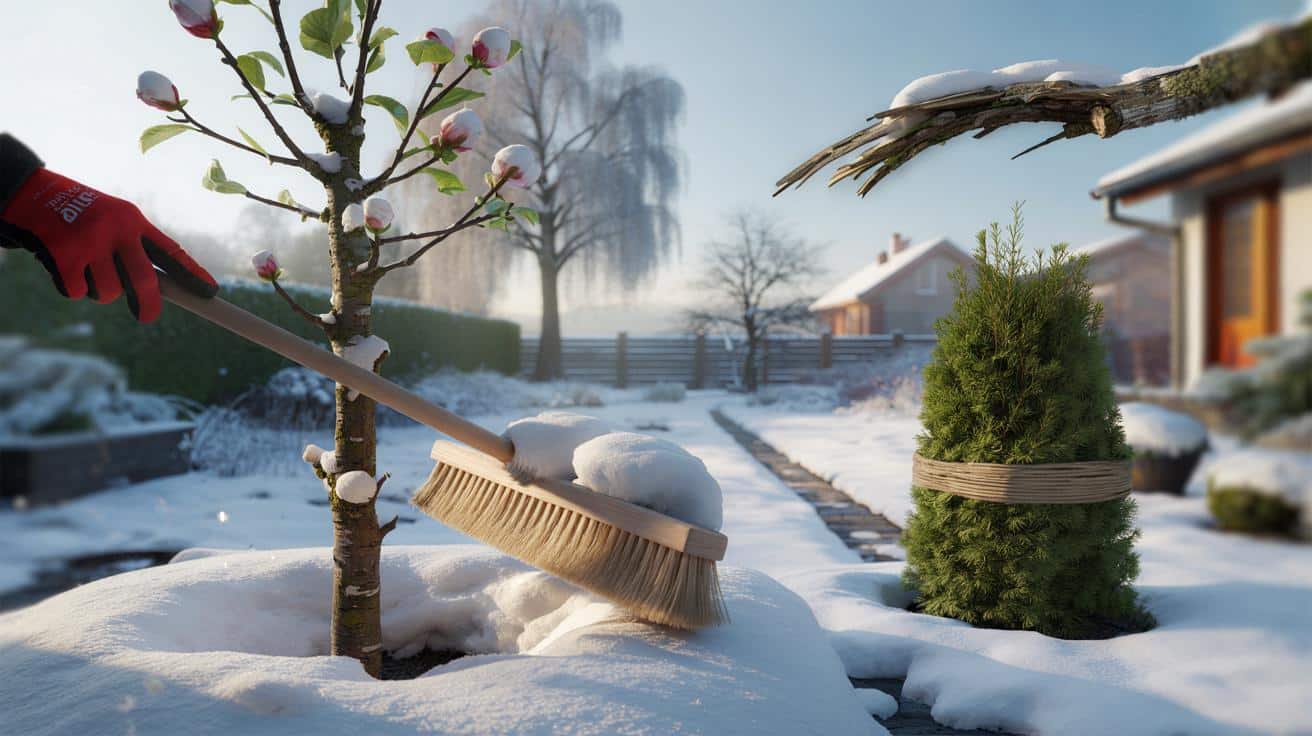
If you need to intervene, think upward, not downward. Use a soft broom and lift snow from below, in layers, starting near the tip and working back toward the trunk. Keep movements slow and small, like teasing flour off a whisk. Prioritize young columnar conifers and multi-stem shrubs that trap snow in pockets. If a thaw is coming in hours, wait. Patience is a winter skill.
Skip the trunk slaps, the pole jerks, the heroic ladder routine. Don’t tug at branches loaded with ice; let ice melt on its own. Never pull snow down—lift it clear. Tie vulnerable evergreens loosely before storms with soft tree tape in a figure-eight, so they support themselves without strangling. Let’s be honest: nobody really does that every day. Do it for your few most precious plants and you’ll sleep better when the forecast turns heavy.
Sometimes the smartest “rescue” is to leave the scene and come back at noon sun. **Never knock, slap, or kick a trunk under load.** If a limb is already cracked, support it gently with a prop and call a pro when you can. Below is the advice I hear most from winter callouts:
“Do no harm first. If it’s iced, wait. If it’s wet snow, lift—don’t shake.”
- Clear paths under trees before you start, so slips don’t become collisions.
- Use a soft broom or padded tool; avoid hard edges and metal hooks.
- Work from the outside in, lifting small amounts with each pass.
- Stop if you hear fibers creak or see bark stretch—walk away and reassess.
- Photograph damage for later pruning decisions in late winter.
After the storm: healing, pruning, and prevention that actually works
Snowstorms tell the truth about structure. A branch that always hung a bit low shows why, a narrow crotch reveals its bad angle. When the sky clears, look without rushing. Clean breaks can be pruned back to the next strong union when the deep cold eases. Ragged wounds are better tidied with one precise cut than left to shred in the wind.
Think in seasons, not hours. In late winter, reduce long, overextended limbs on fruit trees so next year’s load spreads across shorter levers. Thin dense evergreens slightly, so snow has space to fall through instead of banking up like a cornice. Swap summer’s tight ties for winter’s soft, looser wraps. **The best rescue is often restraint.** You’ll start to notice which plants stand proud after every front passes, and which want a nudge toward better balance.
Schneebruch is part weather, part architecture, part human impatience. Share a broom, not a shake. Whisper to the garden with small moves and time on your side. A tree remembers rough hands. It also remembers care.
| Point clé | Détail | Intérêt pour le lecteur |
|---|---|---|
| Lift, don’t shake | Use a soft broom from below, remove snow in thin layers | Reduces breakage risk and protects buds and bark |
| Wait out ice | Allow sun or a brief thaw to loosen ice before touching | Prevents tears and cambium damage from brittle wood |
| Prune for structure | Shorten long levers and thin dense areas in late winter | Builds a tree that sheds snow and resists future storms |
FAQ :
- Should I shake small shrubs to free them from snow?No. Scoop and lift snow off gently with gloved hands or a soft broom from underneath.
- Can a leaf blower help?On powder, yes—at low power and from a distance. On wet snow or ice, it’s useless and can cause flying clumps.
- What if a branch is already cracked?Support it if it’s safe, then prune back cleanly to a strong union when temperatures moderate.
- Are conifers or deciduous trees more at risk?Columnar and dense conifers trap more snow; broad, long deciduous limbs can lever heavy loads. Both can fail for different reasons.
- When is the best time to do structural pruning for snow resilience?Late winter to very early spring, during dormancy, before bud break and while disease pressure is low.