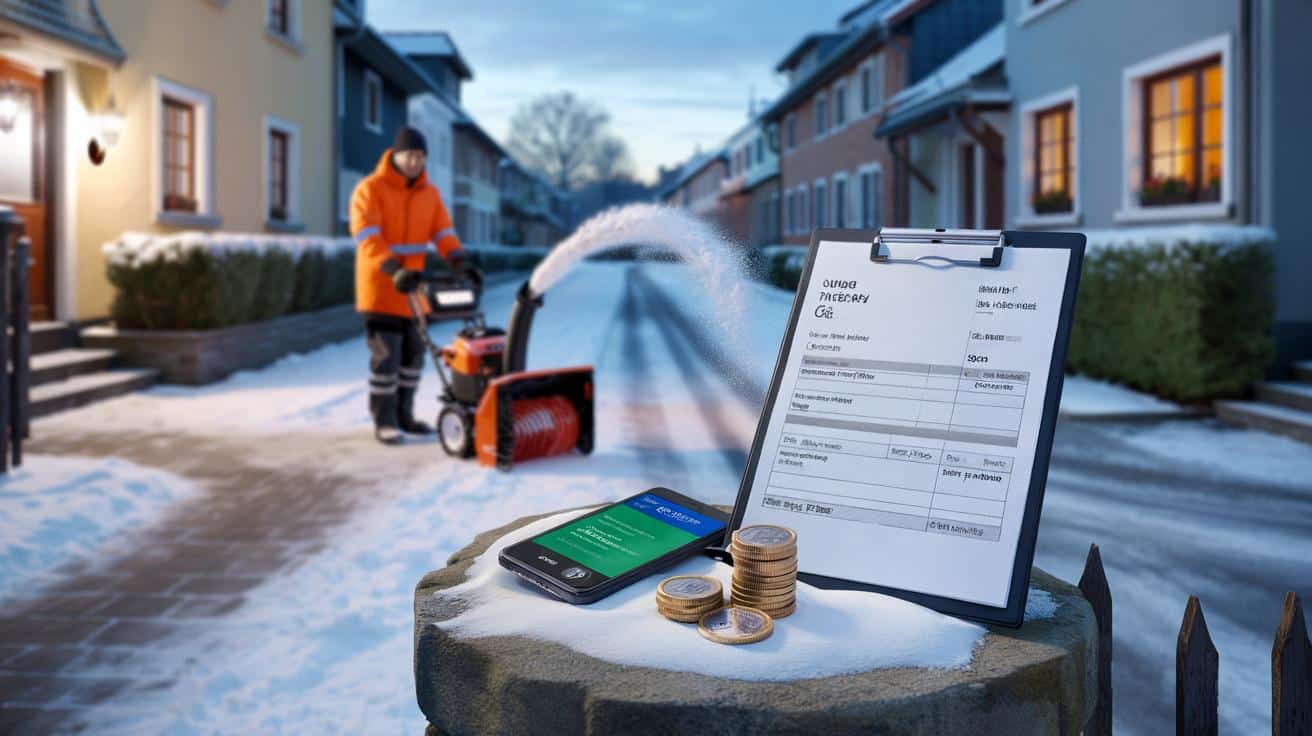
German winter doesn’t ask. It imposes a duty: keep the sidewalk safe, or risk fines and angry stares. Many homeowners outsource the chore because backs fail and mornings are short.
Here’s the part most people miss: that pesky winter service can slice your income tax bill by 20% of the labor cost. No gimmicks. No gray zone. It’s written in §35a EStG, hiding in plain sight.
The twist is simple.
How the 20% tax break actually works
On a quiet street in January, three houses tell three stories. One owner shovels at dawn, another hires a neighbor’s small business, a third leans on the building’s caretaker. All three can trigger the same tax lever: household-related services, the German “haushaltsnahe Dienstleistungen.” You can claim 20% of qualifying labor costs, up to a chunky cap of 4,000 euros per year. That’s not a deduction from income. **It directly cuts your tax bill.**
Think of a standard winter contract: 50 euros per clearing, twenty visits in a cold season. That’s 1,000 euros in labor on the invoice, bank-transferred, properly documented. Your tax cut? 200 euros. A condo building paying 2,400 euros for “Winterdienst” sees the benefit split across owners or even tenants via service charges. A single family paying 600 euros for a careful retiree’s registered service still walks away with 120 euros shaved off their tax. Small numbers add up over long winters.
What counts as “household”? Your property and the sidewalk you must legally keep safe. Yes, that strip of public pavement right outside belongs to the benefit zone, thanks to court rulings that see it as part of your immediate sphere. You need an invoice showing labor separately from materials, a non-cash payment, and paperwork that survives a tax-office glance. The year that matters is the year you paid, not the day the snow fell. Tenants can claim their share from the annual service-charge statement. Landlords usually treat snow costs as rental expenses instead, not both ways.
Turn a cold chore into a warm tax credit
Start with the paperwork. Hire a legit provider or a registered mini-job helper. Ask for an invoice that cleanly separates labor from materials like salt and grit. Pay by bank transfer and keep the transaction proof. In your tax return, find the “Haushaltsnahe Dienstleistungen” section and enter the labor total for winter service. **Cap the expectations:** the law covers 20% of labor up to 20,000 euros, which means a 4,000-euro maximum credit across all household services for the year.
Common trip-ups come fast. People pay in cash, then wonder why the tax cut vanishes. Others bundle snow removal into a “Hausmeister” flat fee, never asking for a breakdown that isolates labor. Some toss the operating-cost statement before April, then panic in June. Let’s be honest: no one really does this every day. One quiet habit fixes it—save the invoice instantly, tag the transfer with “Winterdienst,” and take 90 seconds in your tax app to log the number.
We’ve all lived that moment when heavy snow meets a morning meeting and the phone buzzes with a neighbor’s complaint. Relief doesn’t just come from clear steps—it comes from knowing you won’t pay full price for that relief.
“Snow is seasonal, but the tax benefit is annual. Treat your sidewalk like a line item, not just a nuisance,” says a Munich tax consultant who sees winter invoices all spring.
- Eligible: labor for clearing snow/ice on your property and adjacent sidewalk.
- Eligible: travel time and machine use listed as labor.
- Not eligible: salt, grit, tools, or cash payments.
- Works for owners, tenants, WEG communities; use the share shown in your statement.
- Year of payment rules. Keep invoice + bank proof. No double-claiming with rental expenses.
Why this small credit changes winter decisions
Money isn’t the only motivator, but it helps the right habits stick. A 20% tax offset lowers the mental barrier to hiring help when ice turns mean, or when you’re away every other week. Safety improves. So does the mood of the street at 7 a.m. The state isn’t paying you to avoid a shovel—it’s nudging a safer routine.
For young families, the credit justifies a winter service you’d otherwise postpone. For older owners, it’s dignity: no need to risk a hip on black ice. Tenants who thought tax benefits were a homeowner’s game can suddenly claim their share from the operating-cost breakdown. That’s a quiet democratization of an obscure rule, and it’s wildly practical.
The deeper story lives in the details of German tax culture. Formal invoices. No cash. Clear lines between labor and materials. It sounds fussy until the first time the numbers click and your tax payment shrinks. **The trick isn’t gaming the system—it’s speaking its language.** Once you do, a hard winter looks a little softer, and the morning rush carries less weight.
| Point clé | Détail | Intérêt pour le lecteur |
|---|---|---|
| 20% tax credit | Household-related services under §35a EStG; labor only | Directly reduces tax due, not taxable income |
| Cap and scope | Up to 4,000€ credit per year across all household services | Sets realistic savings for winter contracts |
| Proof matters | Invoice with labor split, bank transfer, yearly allocation | Avoids rejection and unlocks the credit fast |
FAQ :
- Can tenants claim snow removal costs?Yes, if your annual operating-cost statement lists the share for winter service as labor. Enter that amount under household-related services.
- Does clearing the public sidewalk in front of my home qualify?Yes. Courts accept the adjacent public sidewalk as part of the household sphere when you’re legally responsible for it.
- What if I pay my neighbor to shovel?It can qualify only with a proper invoice, bank transfer, and tax compliance on their side. Cash or undeclared work kills the benefit.
- Are salt and materials deductible?No. The credit applies to labor, travel time, and machine use listed as labor. Materials are excluded.
- Can landlords claim this and also deduct it as rental expenses?Pick one logic. For rental property, it’s usually advertising expenses against rental income, not a household-service credit. Owner-occupied homes use the 20% credit.